
Tornado hits Penallt!
[Updated September 5th]
“I was walking my dog in the woods around 8pm when the wind went from zero to pretty terrifying in no time, then all of a sudden, nothing. I ran out the woods pretty darn quickly.”
So wrote Whitebrook resident Gavin Dunkerley about Sunday night (30th August) when a severe and localised weather event hit the village bringing down dozens of trees and causing much damage.
Washing’s Lane clearance (click for full-size)
Most of the damage seems to have been in Blackbrook along Glyn Road but trees were brought down in other parts of the village including The Hoop and Moorcroft Road, near to Pelham Hall.
Blackbrook’s Chris Money “watched it across our little valley, the wind I estimate was around 80mph and went through at least 180 degrees as it moved through lifting a lot of debris and branches. I can only think it must have been a tornado about 4 to 800 mtrs wide. It seemed to move straight down the valley which concurs with the devastation track.”
Down towards the Wye, the Washings area was also badly hit, with Washing’s Lane being totally blocked by fallen trees.
Adam Burtt-Jones’s WhatsApp plea of “Morning, if anyone has some time and chainsaws we’re currently blocked in” brought an immediate response from the community who turned out in number to help clear the debris blocking Washing’s Lane. “Wonderful to have such a helpful community” he posted later on.
Help was also on hand from MCC (despite the Bank Holiday) who helped clear Glyn Road by midday on Monday. Fortunately there was no damage to the OpenReach cable.
James Cooke, also in Glyn Road, reports that “about a third of all my veteran oak, ash, beech and cherry trees were completely uprooted. I estimate about two years of clearance work with professional forestry teams. Utterly devastated after 12 years of blood sweat and tears getting things back under management. Many of the trees were 250 years old.”
His video below shows some of the extent of the damage. More photos of the damage are available here.
The village weather station gave clear evidence for what happened. The barometric graph showed a rapid drop from approximately 1003.5 mb to 1002.0 mb at about 8:00 pm, followed immediately by a sharp rebound.
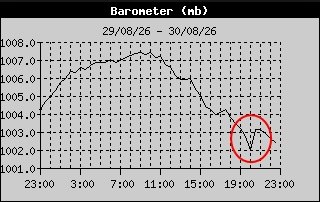
A Google Gemini analysis of this evidence reports: “Tornadoes and intense convective microbursts create localised low-pressure vortices. A rapid drop of roughly 1.5 mb over a very short time window, followed by an immediate recovery, is a classic signature of a mesocyclone or localised vortex passing directly over or near a weather station.
“The 180 degrees rotational wind change is a hallmark of a passing tornadic vortex or strong vortex boundary, as the winds on opposing sides of the core blow in opposite directions.
“Valleys frequently channel severe convective updrafts and downdrafts. While 400 to 800 metres is relatively wide for a typical UK tornado core, it strongly matches the broader damage path of a tornado paired with a localised rear-flank downdraft or a severe squall line/tornado vortex complex."
It was no exaggeration to call it a tornado then!